

Package Theft Prevention
How to Get Delivery Drivers to Use Your Package Delivery Box
Sep
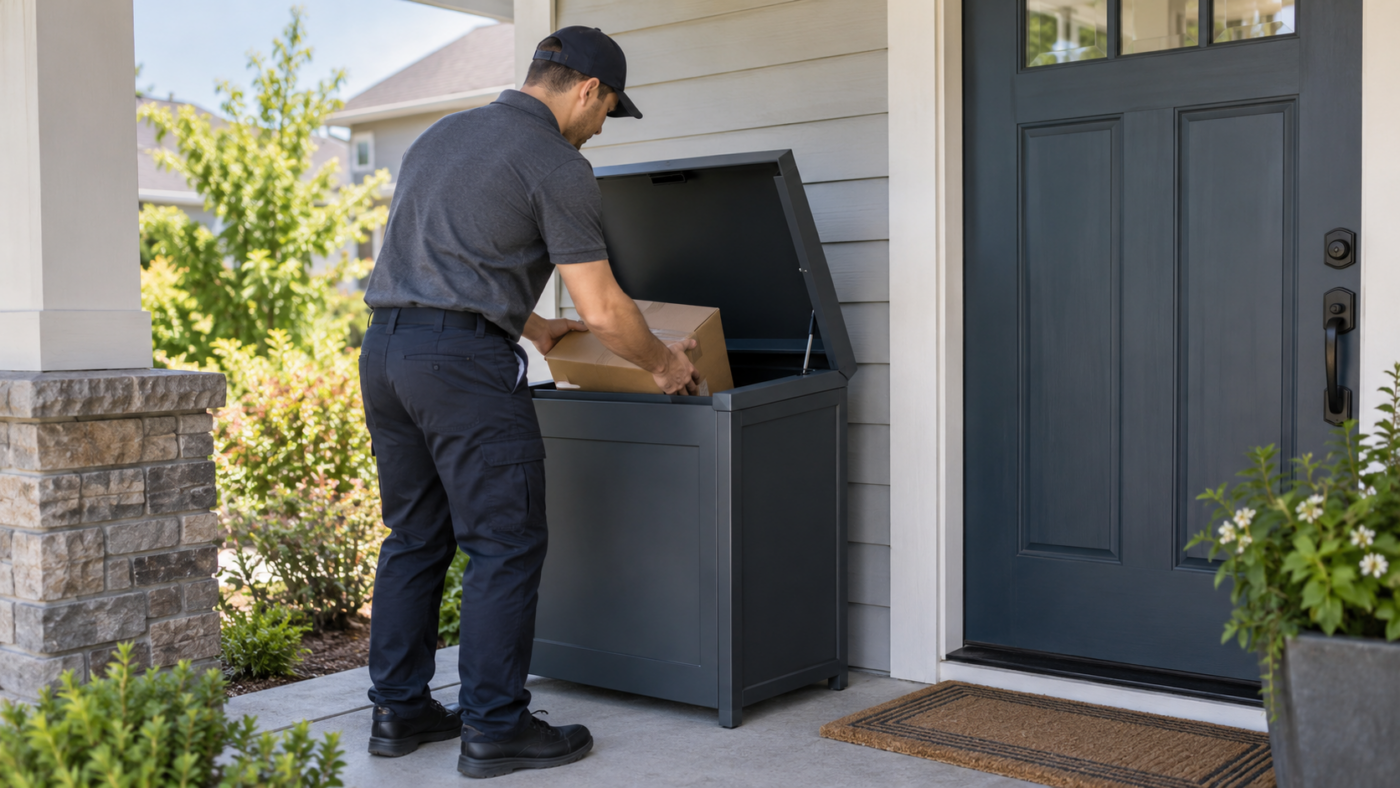
Buying a package delivery box is the easy part. The harder part is getting different delivery drivers to notice it, understand it, and use it consistently.
A box can be well built and securely anchored but still fail as a delivery solution if it is hidden from the driver, difficult to open, poorly labeled, or located away from the normal path to your door. Online delivery instructions can help, but they do not guarantee that every carrier or driver will use a homeowner-supplied box.
The best approach is to treat your package box as part of a delivery system. Put it where a driver can reach it naturally, make its purpose obvious, keep the instructions short, and test the complete setup with real deliveries.
Will Delivery Drivers Use a Package Box?
Delivery drivers can and often do use homeowner-supplied package boxes, but consistent use depends on the setup.
Major carriers provide ways to request a preferred delivery location. UPS My Choice lets customers tell a driver where at the home to leave a package. FedEx Delivery Manager allows residential customers to save delivery instructions for eligible shipments. USPS Delivery Instructions can be used for qualifying mailpieces before they go out for delivery. Amazon customers can also add instructions to a saved address through Your Addresses.
These services improve communication, but they are still only one part of the solution. Some shipments are not eligible to be left unattended, some shippers restrict delivery changes, and a driver may encounter a package that does not fit or a location that is not safe or practical to access.
Consumer Reports described the same basic limitation when evaluating delivery boxes: they can help deter package theft if drivers use them. Real-world homeowner and driver discussions also show mixed results. Although those accounts are anecdotal rather than controlled research, the same problems appear repeatedly: an unmarked box, an opening that is difficult to identify, added handling steps, insufficient capacity, and a box located away from the driver’s normal route.
No single sign or account setting can guarantee compliance. The goal is to remove as many reasons as possible for a driver to leave the package somewhere else.
1. Put the Box Where Drivers Already Go
The best location usually lies at the intersection of three needs:
- The driver can see and reach it without searching.
- The package is less exposed than it would be at the usual drop-off point.
- The homeowner can retrieve packages safely and conveniently.
For many homes, that means placing the box near the front door, porch entrance, garage-side delivery area, or another location drivers already approach. A box hidden around the side of the house may provide better concealment from the street, but that benefit disappears if drivers do not know it is there.
Walk toward your home from the direction a driver normally arrives. Ask:
- Can I see the box before reaching the place where packages are usually left?
- Does the route require opening a gate, walking through a yard, or navigating steps or clutter?
- Would a dog, poor lighting, ice, standing water, or another condition make the location feel unsafe?
- Are the house number and delivery entrance easy to identify?
- Can a driver carrying a large package reach the box without setting the package down first?
Do not choose the most concealed location without considering the driver’s route. A moderately protected box that drivers use is more useful than a perfectly hidden box they regularly miss.
2. Make the Box Easy to See Before the Driver Chooses a Drop-Off Spot
Delivery decisions happen quickly. By the time a driver has reached the front door, the package may already be on the porch and the delivery may already be recorded.
Your package box should therefore be visible before the driver reaches the usual drop-off point. This does not mean it must be highly visible from the street. It means it should be visible from the driver’s approach to the house.
Check the sightline from the walkway, driveway, porch steps, and any other common approach. Make sure the box is not hidden behind:
- Porch furniture
- Planters or seasonal decorations
- Railings or columns
- Parked vehicles
- Trash or recycling containers
- An outward-opening door
A plain deck box or storage container can easily be mistaken for furniture or household storage. If the purpose is not immediately clear, the driver may place the package beside it or on top of it.
Visibility is not only about the container. The label and the delivery opening must also face the direction from which the driver approaches.
3. Make the Box Easy to Understand and Use
A driver should not need to study the box, search for a handle, read several paragraphs, or guess what happens after the package is placed inside.
The most driver-friendly setup has:
- One obvious delivery opening
- A handle, lid, or door that is easy to identify
- A short instruction placed beside the opening
- Enough room for the package
- No unnecessary items stored inside
- No complicated code unless the box genuinely requires one
If the box uses a one-way drop mechanism, make sure the opening moves freely and does not appear locked. If it requires the driver to close a lid or turn a latch, state that action plainly.
Test the box yourself while carrying a package. Can you use it with one hand? Can you tell how it works without prior knowledge? Does the package catch on an internal flap? Could closing the lid damage a larger box?
Also check the box between deliveries. A full box cannot protect the next package, and a driver who finds it full may return to the front door or another familiar location.
If the current box is too small, too complicated, or incompatible with the packages you normally receive, review the practical selection criteria in Package Lock Boxes for Deliveries. If replacement becomes necessary, compare capacity and delivery access—not just locking strength—in Best Package Lock Boxes for Deliveries.
4. Add Delivery Instructions to Carrier and Retailer Accounts
Physical labeling tells the driver what to do after arriving. Account-level delivery instructions can tell the driver what to expect before reaching the door.
Use a short instruction that identifies one specific location. For example:
Place packages inside the clearly labeled delivery box beside the front door.
Avoid long explanations, several alternate locations, or directions that conflict with signs at the property. The wording in the account and the wording at the box should lead to the same place.
For carrier-specific examples and details on where to enter your note, see our guide to writing delivery instructions for Amazon, UPS, FedEx and USPS.
UPS
UPS My Choice allows members to specify where at the home eligible packages should be left. Add the package box as the preferred location as clearly as the available fields allow. Some delivery changes can be limited by the shipper or the type of shipment.
FedEx
FedEx Delivery Manager lets residential customers save package-delivery instructions for future eligible deliveries. FedEx also notes that some shippers restrict available delivery options, so the instruction will not override every shipment requirement.
USPS
USPS Delivery Instructions are available only for eligible mailpieces and generally must be submitted before the item goes out for delivery. When the service is available, select the closest appropriate location and provide a concise note identifying the package box.
Amazon
Amazon customers can go to Your Account → Your Addresses → Add delivery instructions for the delivery address. Describe the box by both its location and its label rather than writing only “use package box.”
Check these instructions periodically. A moved box, new gate, changed entryway, or outdated access code can make an old instruction misleading.
5. Clearly Label the Package Box
A label works best after the box has been placed in a logical, accessible location. It reinforces a good setup; it cannot rescue a box that drivers cannot find or use.
Effective package-box wording should be:
- Short enough to read while approaching
- Direct about the requested action
- High contrast and easy to read
- Weather-resistant
- Visible before the driver chooses another location
“Please place all packages inside this box” is clearer than a label that says only “deliveries” or “packages.” The message tells the driver exactly what action to take.
Place the instruction on the surface facing the driver’s approach. If the delivery opening is on top, make sure the front label is visible before the driver reaches the box. Do not cover the handle, opening, manufacturer directions, or any safety information.
The Package Box Delivery Decal – Please Place All Packages Inside This Box provides that instruction at the point of delivery. It is most useful as the final visual cue in a setup that already has a sensible location and matching carrier instructions.
If drivers must pass an incorrect drop-off point before reaching the box, a directional marker may help. Mark the correct destination positively. Use a “Do Not Leave Packages Here” message only when the preferred location is also clearly identified; a negative sign by itself tells the driver what not to do without showing what to do instead.
6. Test the Setup Across Three Actual Deliveries
Do not assume the system works because the box is installed and the instructions are saved. Test it with several real deliveries.
Three deliveries are usually enough to reveal an obvious placement or communication problem without treating one unusual delivery as a permanent pattern.
For each delivery, record:
- The carrier or delivery service
- The package size
- Whether current delivery instructions were in place
- Whether the package would fit inside the box
- Where the driver left it
- Whether the delivery photo or camera view shows what happened
- The most likely reason the box was used or missed
If the camera does not clearly show the package box and surrounding drop-off area, use the Security Camera Placement Guide to check the viewing angle before relying on the footage to evaluate driver behavior.
If the package is left elsewhere, change one part of the system at a time. Moving the box, replacing the sign, rewriting every carrier instruction, and changing the access method simultaneously will make it difficult to identify what solved the problem.
For example:
- Delivery 1 is left at the door: move the box into the driver’s sightline.
- Delivery 2 is left on top of the box: make the opening and instruction more obvious.
- Delivery 3 is placed inside: keep the successful setup and continue monitoring it occasionally.
The Complete Porch Pirate Protection Toolkit includes a Delivery Zone Planner, Delivery Instructions Builder, Signs & Decals Placement Planner, Package Box / Lockbox Decision Tool, and a Real-World Delivery System Test for evaluating three actual deliveries. These tools are useful when you want to document the process instead of relying on memory.
Why Are Packages Still Being Left Outside the Box?
The location where a package is left often provides a clue about what went wrong.
| What happened | Likely cause | What to adjust |
|---|---|---|
| The package was left on top of the box | The driver saw the box but did not recognize the opening or understand how to use it | Make the opening obvious and place the instruction beside it |
| The package was left at the front door | The box was off the normal route or noticed too late | Move it into the approach sightline or add a clear directional cue |
| One carrier uses the box and another does not | Account instructions, shipment eligibility, or local delivery routines differ | Verify instructions separately for each carrier and continue testing |
| The package was left beside the box | It may not have fit, the box may have been full, or the opening may have looked inaccessible | Check capacity, empty the box promptly, and test the opening with common package sizes |
| The driver stopped at a gate or driveway | The path to the box may not have appeared safe or accessible | Remove the access barrier or choose a location before it |
| A signature-required package was not placed inside | The shipment was not eligible for unattended delivery | Be available to sign or use a carrier-approved hold or redirect option |
| Packages keep going to an old location | Existing habits or conflicting visual cues are overriding the new setup | Update account instructions, remove outdated signs, and clearly identify the new location |
| Use is inconsistent even after improvements | Different drivers or delivery conditions may produce different results | Keep the setup simple, monitor a larger sample, and maintain a backup plan |
Avoid treating every missed box as proof that the entire idea has failed. First determine whether the cause was the box, the package, the location, the instructions, or an exception that the homeowner could not control.
When a Package Box Is Not the Right Delivery Option
Some deliveries need a different plan. A home package box may not work when:
- The package is too large or heavy
- The box is already full
- An adult, direct, or other physical signature is required
- The shipment is age-restricted or otherwise ineligible for unattended delivery
- The driver cannot reach the box safely
- The shipper has restricted delivery changes
- A very high-value package should be held at a secure carrier location instead
For those deliveries, consider an authorized carrier pickup location, package hold, redirect option, signature arrangement, or a delivery day when someone will be home. The Secure Package Delivery Guide explains how those alternatives fit into a broader delivery plan.
Final Package-Box Setup Checklist
Before the next delivery, confirm:
- The box is on or beside the driver’s normal route.
- The driver can see it before reaching the usual drop-off location.
- The approach is safe, clear, and well lit.
- The box is unmistakably labeled for package deliveries.
- The opening and required action are obvious.
- The box is empty and large enough for the expected package.
- Carrier and retailer instructions identify the same location.
- Old or conflicting delivery signs have been removed.
- A delivery photo or camera can help verify the result when available.
- You have a backup plan for packages that cannot be left in the box.
For a broader review of the porch, delivery area, lighting, monitoring, and household routine, work through the Home Delivery Security Checklist.
If you find several weak points and need help choosing what to fix first, take the free 15-Minute Porch & Package Security Checkup to prioritize your next improvements.
The goal is not to give drivers more work. It is to make your package box the fastest, clearest, and most natural place to complete the delivery.
Once that system is in place, test it with real packages. Keep what works, correct what does not, and reassess the setup whenever the delivery location, box, or household routine changes.